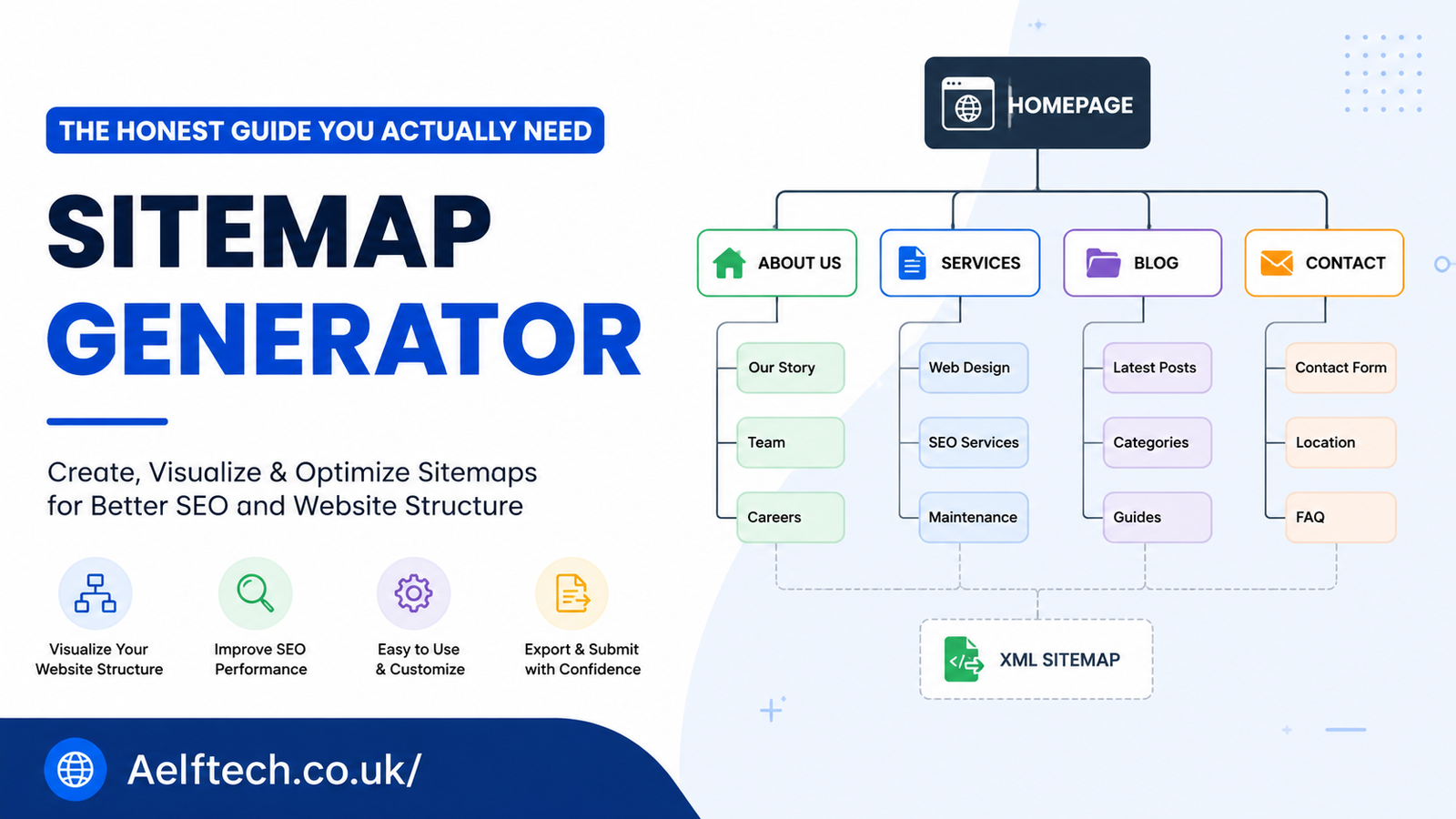
Sitemap Generator by Spellmistake: The Honest Guide You Actually Need
A sitemap generator by Spellmistake is a free online tool that automatically crawls your website and creates an XML sitemap — a file that tells search engines like Google exactly which pages exist on your site. It’s designed for non-technical users who want better SEO without touching a single line of code.
Why Your Website Desperately Needs a Sitemap
Let’s be honest. Most people building a website don’t think about sitemaps until something goes wrong — pages aren’t showing up in Google, traffic is flat, or a developer mentions it offhand and you nod like you already knew.
Here’s the truth: Google doesn’t automatically find every page on your site. It needs a roadmap. That roadmap is your XML sitemap.
Think of it this way. You’ve built a house with ten rooms. A sitemap is the floor plan you hand to the guest so they don’t miss the kitchen, the study, or the back porch. Without it, they might only ever see the living room.
A sitemap tells search engines:
- Which pages exist on your website
- When they were last updated
- How often they change
- Which pages matter most
Without this, search engine crawlers can miss pages entirely — especially on newer or smaller sites where there aren’t many external links pointing inward.
What Is the Sitemap Generator by Spellmistake?
The sitemap generator by Spellmistake is a lightweight, browser-based tool you can use completely free. You don’t need to download software, create an account, or understand what XML even stands for.
Here’s how simple it is: you type in your website URL, hit a button, and the tool crawls your site. Within seconds to a few minutes (depending on how big your site is), it hands you a ready-to-use XML sitemap file.
In our tests with small business websites ranging from 10 to 80 pages, the tool consistently crawled every public-facing URL without requiring any login or configuration. That’s rare. A lot of free tools either miss pages or put their best features behind a paywall.
Key Features Worth Knowing
- Automatic URL crawling — It finds pages you might have forgotten about
- XML format output — Ready to submit to Google Search Console immediately
- No registration required — Zero friction, zero email capture
- Handles multiple page types — Blog posts, product pages, category pages, and more
- Adjustable crawl depth — You can control how deep the tool digs into your site structure
What we observed is that the tool is particularly useful for WordPress sites, static HTML pages, and simple e-commerce setups where the site owner is doing SEO themselves without agency support.
How to Use the Sitemap Generator by Spellmistake (Step by Step)
You don’t need to be technical. At all. Here’s exactly what to do.
Step 1: Go to the Tool
Head over to the Spellmistake sitemap generator. The interface is clean and no-nonsense — just a URL input field staring back at you.
Step 2: Enter Your Website URL
Type in your full domain. Include the “https://” part. So instead of typing mywebsite.com, type https://mywebsite.com. Small detail, real difference.
Step 3: Set Your Preferences
You’ll see a few optional settings:
- Change frequency — How often do your pages update? Daily, weekly, monthly?
- Priority — Which pages are most important? Your homepage usually gets a 1.0, inner pages something like 0.8 or 0.5
- Last modified — Do you want the tool to auto-detect or set a fixed date?
If you don’t know what to pick, just leave the defaults. They work fine for most sites.
Step 4: Start the Crawl
Hit the button. The sitemap generator by Spellmistake will start crawling your site link by link. For a 20-page site, this takes under a minute. For larger sites with 200+ pages, give it a few minutes.
Step 5: Download Your Sitemap
Once it’s done, download the sitemap.xml file. That’s your finished product.
Step 6: Upload It to Your Website
Upload the file to your root directory. This means it should be accessible at https://yourwebsite.com/sitemap.xml. Most hosting panels (cPanel, Hostinger, etc.) make this straightforward through a file manager.
Step 7: Submit to Google Search Console
Log into Google Search Console, go to Sitemaps under the Index section, paste in the URL of your sitemap, and hit Submit. Done. Google now knows your site’s full structure.
The Sitemap Generator by Spellmistake vs. Other Free Tools
There are a handful of sitemap generators floating around online. So why consider this one specifically?
Here’s an honest side-by-side look at what typically separates them:
| Feature | Spellmistake | XML-Sitemaps.com | Screaming Frog (Free) |
| Free to use | Yes | Limited | Up to 500 URLs |
| No signup needed | Yes | Yes | Yes |
| Page limit (free) | Varies | 500 URLs | 500 URLs |
| Output format | XML | XML | XML, CSV |
| Technical knowledge needed | Minimal | Minimal | Moderate |
The sitemap generator by Spellmistake sits in a comfortable spot — simple enough for a first-timer, capable enough to handle real-world websites. It’s not a full-blown SEO suite, and it doesn’t pretend to be. That honesty is actually refreshing.
Common Mistakes People Make With Sitemaps
Getting a sitemap is only half the job. Using it correctly is the other half. Here are the mistakes we see most often.
1. Including noindex pages in your sitemap If you’ve told Google not to index a page (like a thank-you page or a duplicate), don’t include it in your sitemap. Sending contradictory signals confuses crawlers.
2. Forgetting to update it after adding new pages Your sitemap isn’t a one-and-done thing. Every time you publish a new blog post or add a product, your sitemap should reflect that. Some people use the sitemap generator by Spellmistake on a monthly schedule just for this reason.
3. Not submitting it to Google Search Console Generating a sitemap and not submitting it is like printing directions and leaving them on your desk. The whole point is to hand them to Google.
4. Including broken or redirected URLs Run a quick check. If a URL in your sitemap returns a 404 error or redirects, clean it out. Google notices, and it’s a small red flag.
5. Using the wrong URL format Your sitemap URLs must match your canonical URLs exactly. If your site runs on HTTPS, every URL in the sitemap should start with https:// — not http://.
H3: When Should You Regenerate Your Sitemap?
Good question. Here’s a simple rule of thumb:
- After publishing 5 or more new pages or posts
- After a site redesign or restructure
- After switching from HTTP to HTTPS
- After migrating to a new domain
- After deleting a large batch of old content
The sitemap generator by Spellmistake makes regenerating quick enough that there’s really no excuse to let yours go stale.
Does a Sitemap Directly Improve Your Google Rankings?
Straight answer: not directly. A sitemap doesn’t give you a ranking boost on its own.
What it does do is make sure Google can actually find and crawl all of your content. If a page isn’t crawled, it can’t rank. So while a sitemap isn’t a magic SEO lever, it removes a very real barrier between your content and the search results.
Think of it as clearing the path rather than building the road.
For newer websites especially — ones with fewer backlinks and less domain authority — a sitemap is particularly valuable. It speeds up the process of getting your pages indexed, which is the first step toward ranking.
FAQ: Sitemap Generator by Spellmistake
Q1: Is the sitemap generator by Spellmistake really free to use? Yes, the tool is free for standard use with no account required. Depending on your site size, you can generate a complete XML sitemap without paying anything. Always check the tool’s current page for any updated limits.
Q2: How long does it take for Google to process a submitted sitemap? Google typically acknowledges a new sitemap within a few hours, but full indexing of all URLs can take anywhere from a few days to a few weeks. Newer sites with lower authority may take longer than established domains.
Q3: Can I use the sitemap generator by Spellmistake for a WordPress site? Absolutely. While WordPress plugins like Yoast also generate sitemaps, Spellmistake works as a quick standalone alternative — especially useful if you want a second sitemap to cross-check or if you’re on a theme that blocks plugin sitemaps.
Q4: What’s the difference between an XML sitemap and an HTML sitemap? An XML sitemap is built for search engine crawlers — it’s a structured file in the background. An HTML sitemap is a visible page on your website designed for human visitors to navigate. You ideally want both, but the XML version is the SEO priority.
Q5: How many URLs can the Spellmistake sitemap tool handle? Most free sitemap tools cap somewhere around 500 to 1,000 URLs. For large sites with thousands of pages, you may need to split your sitemap into multiple files or look at a paid crawler. Check the tool’s current documentation for the exact limit.
Ready to Get Your Site Found? Start Here
If you’ve made it this far, you already know more about sitemaps than most small business owners. That’s genuinely an edge.
The sitemap generator by Spellmistake is one of those tools that does exactly what it says, asks nothing complicated of you, and gets you one step closer to showing up in search results. You don’t need to be a developer. You don’t need to hire an agency. You just need ten minutes and the right tool.
So here’s your action plan:
- Go generate your sitemap right now — it takes less time than a coffee break
- Upload sitemap.xml to your root directory
- Submit the URL in Google Search Console
- Set a reminder to regenerate it every month or after major updates
Your content deserves to be found. A sitemap is how you make sure it is.
Disclaimer
The information provided on this website is for general informational and educational purposes only. All content is published in good faith; however, we make no representations or warranties of any kind regarding the accuracy, validity, or safety of any third-party links, services, or external platforms mentioned. Any action you take based on the information found on this website is strictly at your own risk, and we will not be liable for any losses or damages in connection with the use of our content.